
MA VS MEDIGAP IN UTAH
Medicare Advantage vs Medicare Supplement in Utah: 5 Key Differences and a Quick Quiz
Medicare Advantage vs Medicare Supplement comes down to one trade-off. Medicare Advantage replaces how you get Part A and Part B, uses a network, and has a yearly out-of-pocket limit. A Medicare Supplement (Medigap) works alongside Original Medicare, lets you see any provider in the U.S. that accepts Medicare, and helps pay your share of costs. You can’t have both at once.
Sources: Medicare.gov – Compare Original Medicare and Medicare Advantage · Medicare.gov – What’s Medicare Supplement Insurance (Medigap)?
This Medicare Advantage vs Medicare Supplement guide is for Utahns turning 65, retirees moving to Utah, and family members helping a parent decide. It covers the five differences that matter most, how costs behave in a light year and a heavy year, the switching rules most people learn too late, and a short quiz that shows which features match your answers. I’m Fores Boo, a licensed independent Medicare agent in Draper, licensed since 2014. I’ve helped 1,000+ Utahns with Medicare.
New to Medicare? Start with the Medicare Utah guide.
Want to talk through your choice?
There’s no cost to you for my help.
TWO STRUCTURES
Medicare Advantage vs Medicare Supplement: two different structures
Medicare Advantage (Part C)
A private plan approved by Medicare covers your Part A and Part B services instead of Original Medicare. Most plans include Part D drug coverage and some extra benefits. You use the plan’s network and follow its rules. Learn more in the guide to Medicare Advantage plans in Utah.
Medicare Supplement (Medigap)
You keep Original Medicare as your main coverage. A Medigap policy from a private company pays some or all of what Original Medicare leaves you, such as deductibles and the 20% coinsurance. You add a separate Part D plan for drugs. See how Medicare Supplement plans work in Utah.
You can’t use a Medigap policy with a Medicare Advantage plan. It’s one path or the other. (Medicare.gov – How Medigap works)
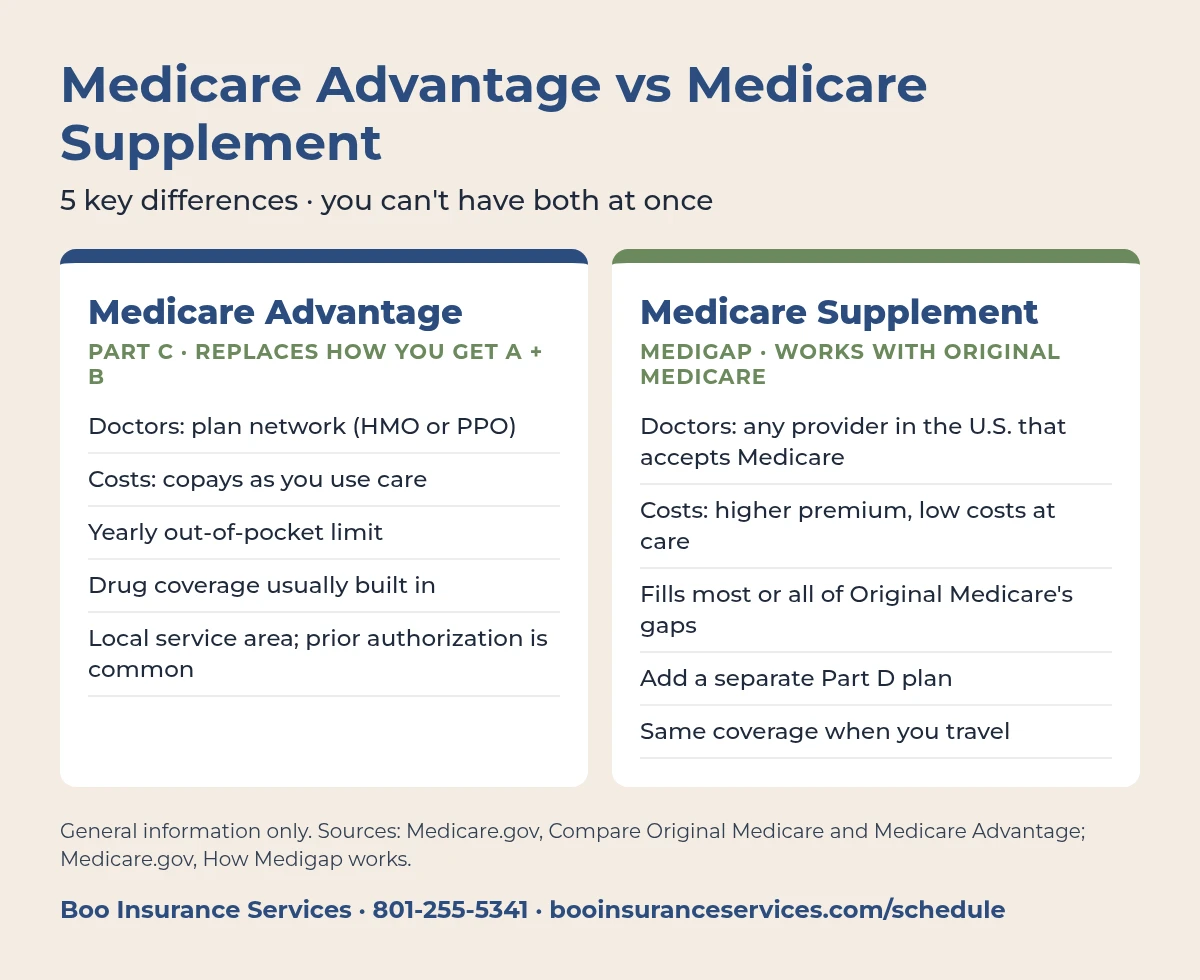
5 DIFFERENCES
The 5 key differences between Medicare Advantage and Medicare Supplement
1. Doctors and hospitals
- Medicare Advantage: you generally use the plan’s network. HMOs often need referrals; PPOs let you go out of network at a higher cost.
- Medigap: any doctor or hospital in the U.S. that accepts Medicare. No network and no referrals.
2. How you pay
- Medicare Advantage: you pay your Part B premium, any plan premium, and copays or coinsurance as you use care.
- Medigap: you pay your Part B premium, a monthly Medigap premium and a Part D premium. In return, your costs when you get care are lower and more predictable.
3. Yearly out-of-pocket limit
- Medicare Advantage: every plan has a yearly limit on covered Part A and Part B costs. Medicare’s 2026 in-network limit is $9,250, and many plans set a lower one. (CMS – Medicare Advantage rates & statistics (CY 2026 MOOP limits))
- Original Medicare alone: no yearly limit. A Medigap policy fills most or all of that gap, depending on the plan type.
4. Drug coverage and extras
- Medicare Advantage: drug coverage is usually built in, and many plans add some dental, vision or hearing benefits.
- Medigap: plans sold after 2005 don’t include drug coverage, and there are no extras. You add a separate Part D plan. In 2026, Part D out-of-pocket drug costs are capped at $2,100 a year on either path. (Medicare.gov – Drug coverage costs)
5. Travel and prior authorization
- Medicare Advantage: built around a local service area; routine care away from home may be limited. Many plans require prior authorization for some services.
- Medigap: works the same in St. George, Logan or out of state. In most cases, Original Medicare doesn’t require prior authorization. (Medicare.gov – Compare Original Medicare and Medicare Advantage)
QUICK QUIZ
Medicare Advantage vs Medigap quiz
Answer six quick questions to see which features line up with what matters to you. It isn’t a recommendation and doesn’t ask for personal details. Your answers stay on your device.
Medicare Advantage vs. Medigap: which features fit you?
Answer 6 quick questions about travel, doctors, budget and health. The quiz explains which path's features line up with your answers and why. It is educational only and is not a recommendation of any plan.
Feature descriptions: Medicare.gov, "Compare Original Medicare & Medicare Advantage" and "What's Medicare Supplement Insurance (Medigap)?" (2026). This quiz is general education, not a recommendation or an offer of any plan or carrier. Costs, networks and benefits vary by plan and change every year. Results are estimates for education only. Boo Insurance Services, Fores Boo, licensed agent (NPN 17255694). Not affiliated with or endorsed by the U.S. government or the federal Medicare program.
LIGHT YEAR VS HEAVY YEAR
Costs in a light year vs a heavy year
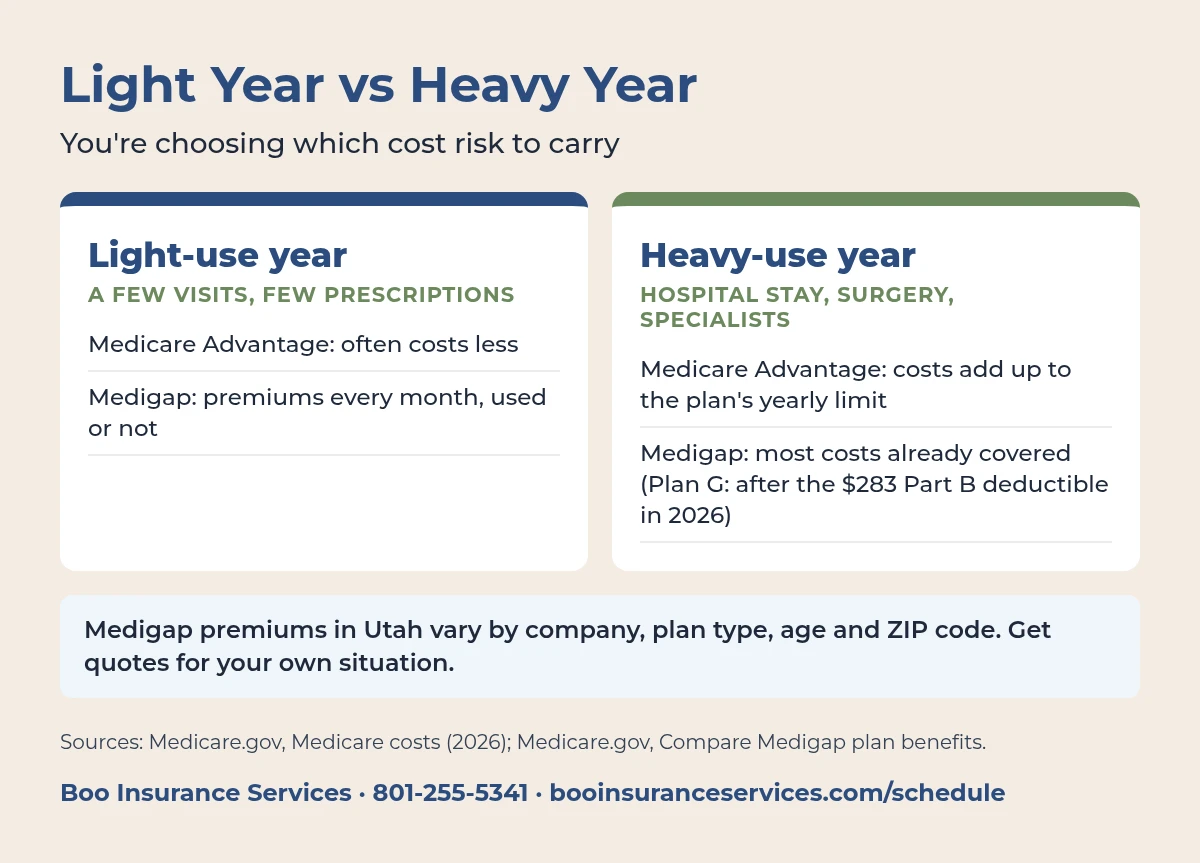
You aren’t really choosing the cheaper plan. You’re choosing which kind of cost risk you’d rather carry.
In a light-use year
With Medicare Advantage, you might pay little beyond your Part B premium if your plan has a low premium and you only need a few visits. With Medigap, you pay the Medigap and Part D premiums every month whether or not you use care.
In a heavy-use year
A hospital stay, surgery or months of specialist care add up under Medicare Advantage until you reach your plan’s out-of-pocket limit. With Medigap, most of those costs are already covered. For example, Plan G covers the benefits in its Medicare.gov chart except the Part B deductible ($283 in 2026), so after that deductible your share of Medicare-covered costs is mostly paid. (Medicare.gov – Compare Medigap plan benefits · Medicare.gov – Medicare costs)
Medigap premiums in Utah differ by company, plan type, age and ZIP code, so get real quotes for your situation rather than relying on averages.
SWITCHING RULES
Switching between Medicare Advantage and Medicare Supplement later
Moving from Medigap to Medicare Advantage
You can switch to a Medicare Advantage plan during Open Enrollment, October 15 to December 7, without health questions. See the Utah Medicare Open Enrollment guide.
Moving from Medicare Advantage back to Medigap
This is the harder direction. Outside your protected windows, a Medigap company may ask health questions and can charge more or turn you down.
- Your Medigap Open Enrollment Period: 6 months starting the first month you have Part B and are 65 or older. During this window, a company can’t deny you or charge more because of your health. It happens once, not every year. (Medicare.gov – Get ready to buy Medigap)
- The trial right: if you joined a Medicare Advantage plan when you were first eligible at 65 and, within the first 12 months, switch back to Original Medicare, you have the right to buy any Medigap policy sold in Utah. If you dropped a Medigap policy to join Medicare Advantage for the first time, you can switch back within 12 months and buy the policy you had before, if the same company still sells it. If it doesn’t, you can buy certain other Medigap policies. Apply up to 60 days before, and no more than 63 days after, your Medicare Advantage coverage ends. (Medicare.gov – When can I buy Medigap? · Medicare.gov – How Medigap works)
- Other guaranteed issue rights: for example, if your Medicare Advantage plan leaves Medicare or stops serving your area, or you move out of its service area. State law can add more rights, so check with the Utah Insurance Department.
This is why your first choice at 65 matters. See Medicare enrollment dates in Utah and turning 65 in Utah to line up your timing. If your plan is leaving next year, read what to do if your Medicare Advantage plan is ending in 2027.
Not sure which window you’re in?
There’s no cost to you for my help.
WHO EACH FITS
Who each path tends to fit
Medicare Advantage may fit if you:
- Have doctors and a hospital that are all in a plan’s network.
- Want drug coverage and medical coverage in one plan.
- Prefer a lower monthly cost and are fine with copays when you use care.
- Spend most of the year in your plan’s service area.
- Are comfortable with referrals and prior authorization.
A Medicare Supplement may fit if you:
- See several specialists or have ongoing health conditions.
- Want to see any provider that accepts Medicare, anywhere in the U.S.
- Prefer predictable costs, even if the monthly premium is higher.
- Split time between Utah and another state.
- Are inside your Medigap Open Enrollment Period, when health questions don’t apply.
These are starting points. Your doctors, prescriptions and the plans offered in your county decide the details. Compare plans in your ZIP code on Medicare.gov’s plan finder, or ask Utah’s SHIP program for neutral counseling.
LOCAL HELP
Why Utahns ask me to compare both paths
I’m an independent agent, so I can explain both Medicare Advantage and Medicare Supplement options side by side. I’ve been licensed since 2014, have helped 1,000+ Utahns with Medicare, and Boo Insurance Services is 5-Star Rated on Google. Reviews are by phone or video, anywhere in Utah.
COMMON QUESTIONS
Frequently asked questions
Medicare Advantage replaces how you get Part A and Part B and uses a network, with a yearly out-of-pocket limit. A Medicare Supplement works with Original Medicare, lets you see any provider that accepts Medicare, and helps pay your share of costs.
No. A Medigap policy can’t be used with a Medicare Advantage plan. You choose Original Medicare with a Medigap policy and a Part D plan, or a Medicare Advantage plan.
It depends on how much care you use. Medicare Advantage often costs less each month, but costs rise with use up to the plan’s yearly limit. Medigap has higher monthly premiums but lower, more predictable costs when you need care.
Yes, but outside protected windows a Medigap company may ask health questions and can decline you. If you joined Medicare Advantage when first eligible at 65 and switch back to Original Medicare within 12 months, you have a guaranteed right to buy a Medigap policy.
Yes. Medigap plans sold after 2005 don’t include drug coverage, so most people add a Part D plan. Medicare Advantage plans usually include drug coverage.
A Medicare Supplement works with any provider in the U.S. that accepts Medicare, so it’s often simpler for travelers. Medicare Advantage covers emergencies anywhere in the U.S., but routine care outside the service area may be limited.
Your 6-month Medigap Open Enrollment Period, which starts the first month you have Part B and are 65 or older. During that window, companies can’t deny you or charge more because of your health.
Decide on Medicare Advantage vs Medicare Supplement with local help
Bring your doctor list, your prescriptions and your quiz results. I’ll explain how each path would work for you in your county, and you decide.
Ready to compare both paths?
There’s no cost to you for my help.
NEXT STEP
Sources
- Medicare.gov, Compare Original Medicare and Medicare Advantage: https://www.medicare.gov/basics/get-started-with-medicare/get-more-coverage/your-coverage-options/compare-original-medicare-medicare-advantage
- Medicare.gov, What’s Medicare Supplement Insurance (Medigap)?: https://www.medicare.gov/health-drug-plans/medigap
- Medicare.gov, Get ready to buy Medigap: https://www.medicare.gov/health-drug-plans/medigap/ready-to-buy
- Medicare.gov, How Medigap works: https://www.medicare.gov/health-drug-plans/medigap/basics/how-medigap-works
- Medicare.gov, When can I buy Medigap?: https://www.medicare.gov/health-drug-plans/medigap/ready-to-buy/when
- Medicare.gov, Compare Medigap plan benefits: https://www.medicare.gov/health-drug-plans/medigap/basics/compare-plan-benefits
- CMS, Medicare Advantage rates & statistics (CY 2026 MOOP limits): https://www.cms.gov/medicare/payment/medicare-advantage-rates-statistics
- Medicare.gov, Medicare costs (2026 Part B premium and deductible): https://www.medicare.gov/basics/costs/medicare-costs
- Medicare.gov, How much does Medicare drug coverage cost?: https://www.medicare.gov/health-drug-plans/part-d/basics/costs
- Medicare.gov, Plan finder: https://www.medicare.gov/plan-compare/
- Utah Insurance Department: https://insurance.utah.gov/
- Utah DHHS Aging & Adult Services, SHIP: https://daas.utah.gov/seniors/
Last updated: October 2026
Disclaimer: We do not offer every plan available in your area. Any information we provide is limited to those plans we do offer in your area. Please contact Medicare.gov, 1-800-MEDICARE, or your local State Health Insurance Program (SHIP) to get information on all of your options.
Not connected with or endorsed by the United States government or the federal Medicare program. National Producer Number: 17255694
About the author: Fores Boo is a licensed independent Medicare agent, NPN 17255694, with Boo Insurance Services, 61 W 13490 S Ste 201, Draper, UT 84020 · 801-255-5341. Reviews are by phone or video.