
STILL WORKING AT 65
Still Working at 65? How Medicare Works With Employer Coverage, HSAs and COBRA
If you’re 65 or older and covered by a job-based plan, who pays first depends on employer size. With 20 or more employees, the employer plan usually pays first and you can often delay Part B without a penalty. With fewer than 20, Medicare usually pays first. When the job or the coverage ends, you have 8 months to sign up for Part B using forms CMS-40B and CMS-L564.
Sources: Medicare.gov – Who pays first? · Medicare.gov – When does Medicare coverage start?
This guide is for Utahns who are 65 or older, or turning 65 soon, and still working (or covered through a working spouse). It explains the employer size rule, your 8-month Special Enrollment Period, how to fill out form CMS-L564 and CMS-40B, what happens to HSA contributions, why COBRA doesn’t protect you from the Part B penalty, and how Part D creditable coverage works.
New to Medicare? Start with the Medicare Utah guide or turning 65 in Utah: your Medicare roadmap.
Want someone to check your dates?
There’s no cost to you for my help.
WHO PAYS FIRST
Who pays first: the 20-employee rule
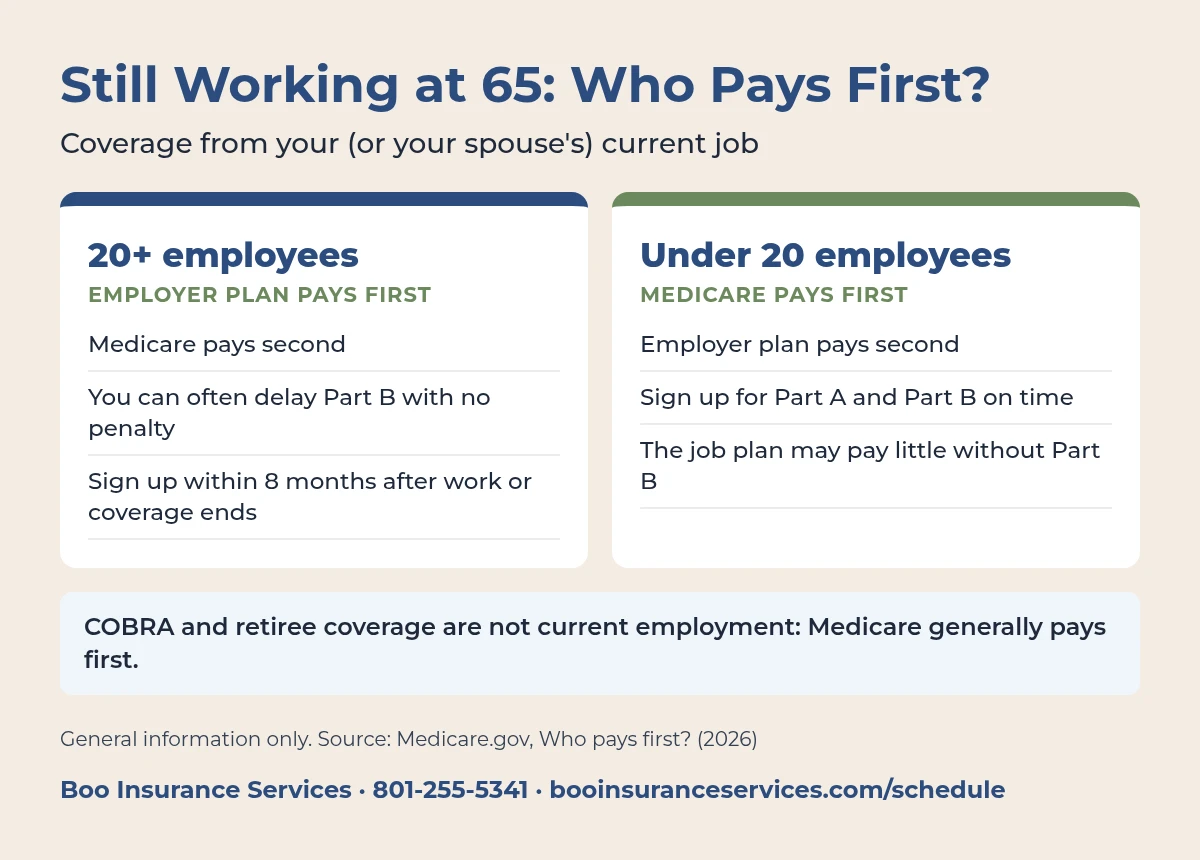
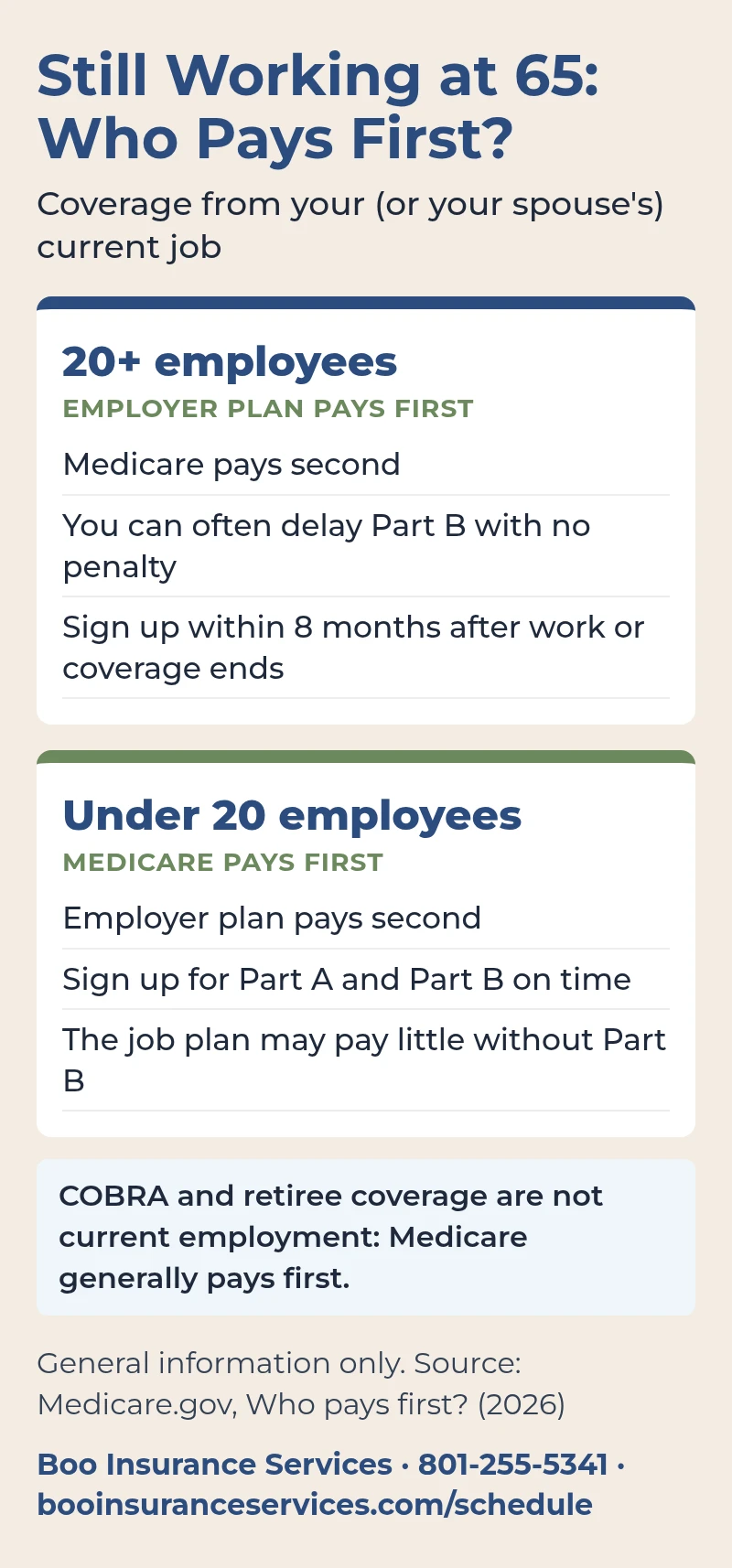
20 or more employees: the employer plan pays first
If you’re 65 or older and have group health coverage from your own or your spouse’s current job, and the employer has 20 or more employees, the group plan generally pays first and Medicare pays second. The same applies if a smaller employer is part of a multi-employer plan where at least one employer has 20 or more employees. Many people in this spot keep the job plan and wait on Part B. (Medicare.gov – Who pays first?)
Fewer than 20 employees: Medicare pays first
If the employer has fewer than 20 employees (and isn’t in a larger multi-employer plan), Medicare pays first and the group plan pays second. If you skip Part B, the job plan may pay little for care Medicare would have covered first. In that case, sign up for Part A and Part B during your 7-month Initial Enrollment Period. (Medicare.gov – How Medicare works with other insurance)
Employers with 20 or more employees must offer workers 65 and older the same health benefits, under the same conditions, as younger workers. Ask HR in writing how many employees the company has and whether the plan pays first or second.
DECISION HELPER
Medicare decision helper: still working at 65
Answer four questions to see who usually pays first, whether Part B can wait, and what to do about an HSA and drug coverage. Your answers stay on your device.
Still working at 65? Medicare decision helper
For people 65 or older (or turning 65 soon) who have, or recently had, health coverage from a job. Answer 4 questions to see who pays first, whether Part B can wait, and what to do about an HSA and drug coverage.
Want me to check your dates and forms?
Call or book a time and I'll walk through your employer coverage, your HSA timing and the CMS-40B and CMS-L564 with you. There's no cost to you for my help.
Sources (checked Oct. 2026): Medicare.gov: Who pays first (opens in a new tab); Medicare.gov: When coverage starts (opens in a new tab); CMS-40B and CMS-L564 forms (CMS.gov); IRS Publication 969. This helper is general education only, does not name or recommend any plan or carrier, and is not tax advice. Your answers stay in this browser and are not saved or sent. Boo Insurance Services, Fores Boo, licensed agent (NPN 17255694). Not affiliated with or endorsed by the U.S. government or the federal Medicare program.
YOUR 8-MONTH WINDOW
Your Special Enrollment Period: the 8-month window
How the window works
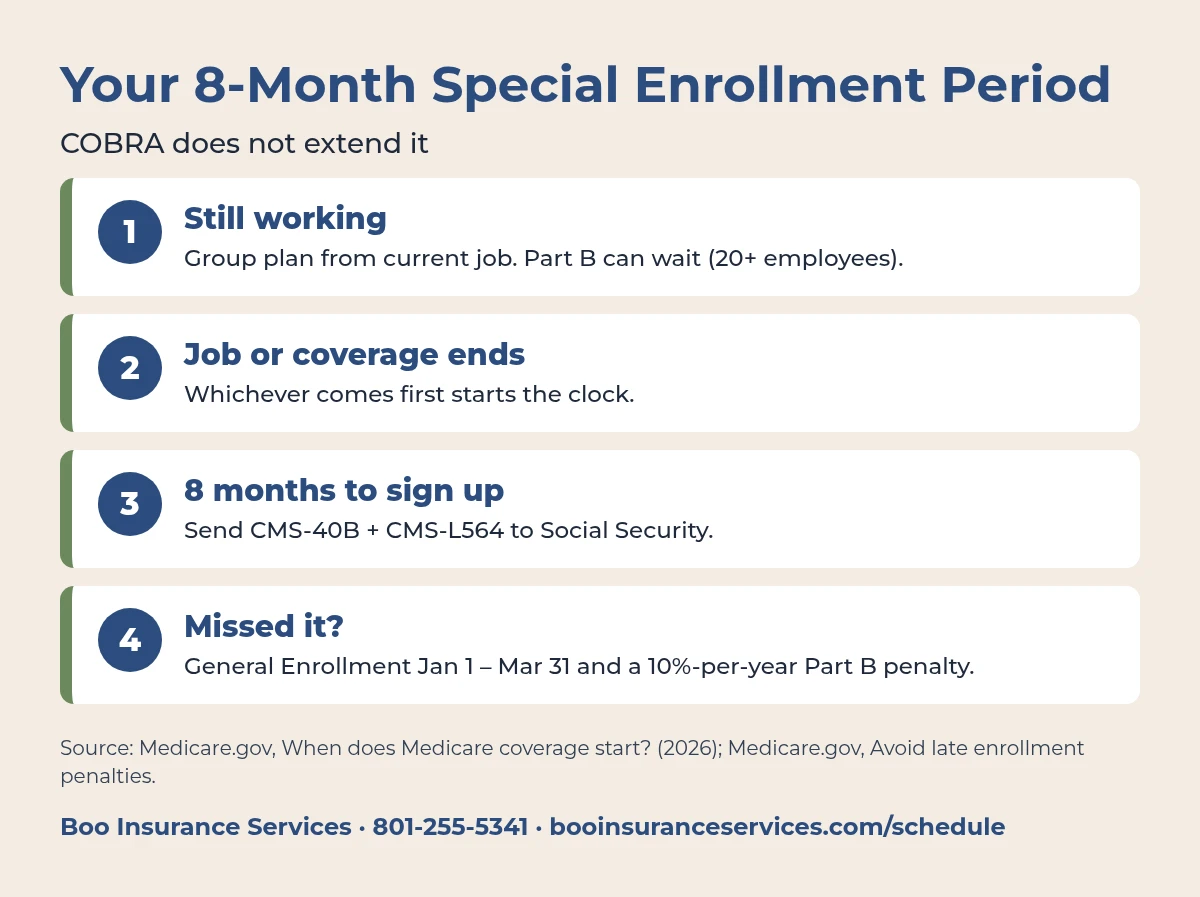
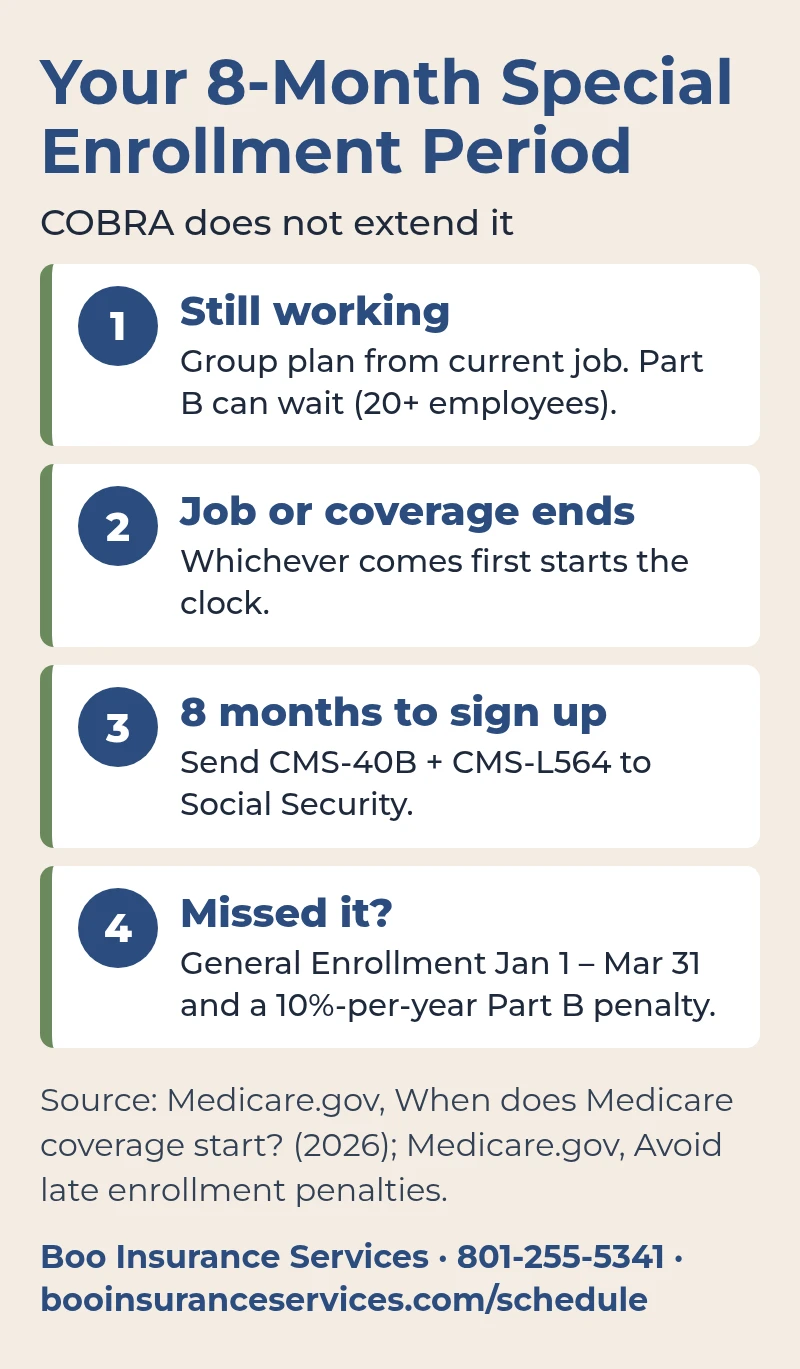
If you delayed Part B because you had group coverage from current work, you get a Special Enrollment Period. It runs while you’re covered, and it ends 8 months after the employment or the group coverage ends, whichever happens first. Coverage generally starts the month after you sign up. If you sign up while still working, or in the first full month after the job coverage ends, you can ask to delay your Part B start date up to 3 months. (Medicare.gov – When does Medicare coverage start?)
If you miss it
Missing the 8-month window means waiting for the General Enrollment Period, January 1 to March 31, with coverage starting the month after you sign up. You may also owe a Part B late enrollment penalty of 10% for each full 12-month period you could have had Part B but didn’t. It’s added to the standard premium ($202.90 a month in 2026) for as long as you have Part B. (Medicare.gov – Avoid late enrollment penalties)
Run your numbers with the Medicare penalty calculator Utah and see every window in Medicare enrollment dates in Utah.
THE FORMS
Form CMS-L564 and CMS-40B: how to fill them out and where to send them
CMS-40B: Request for Enrollment in Medicare Part B
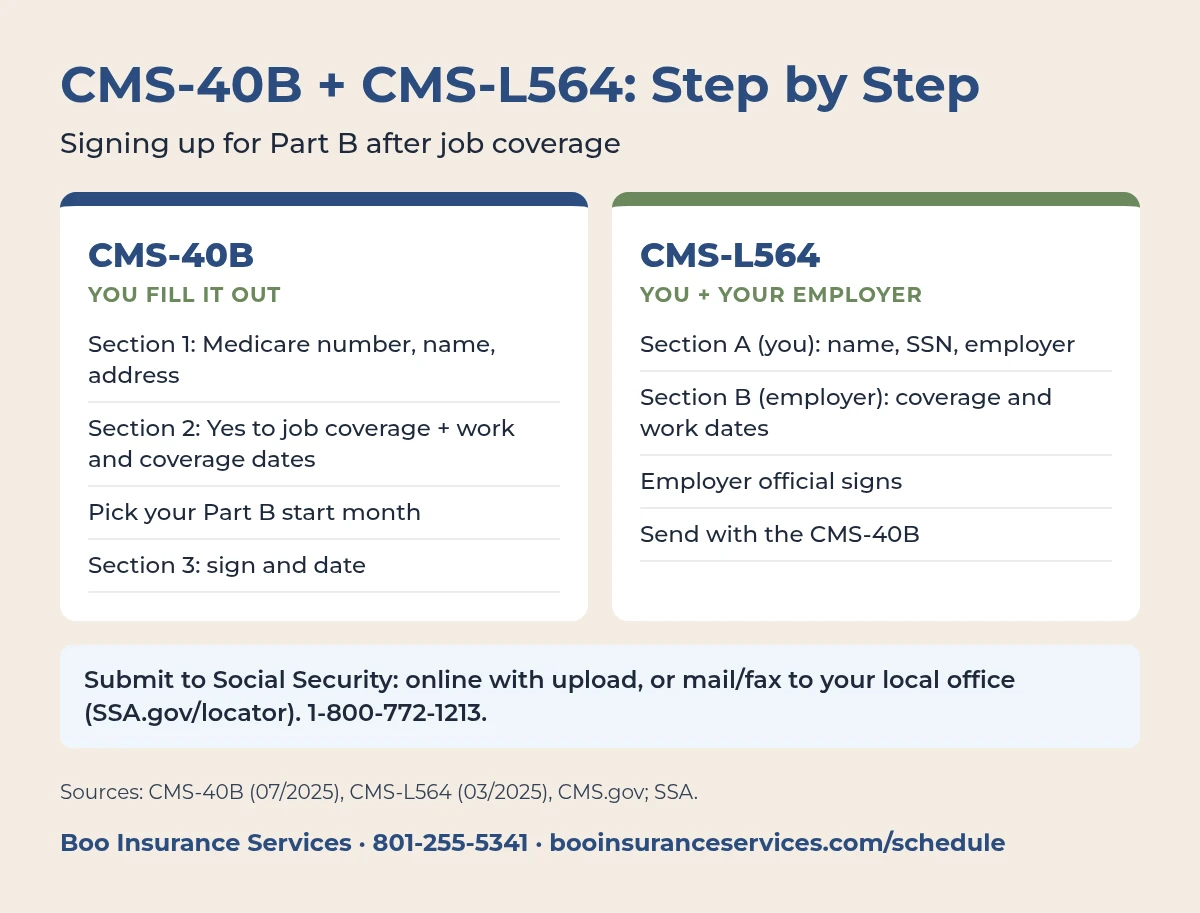
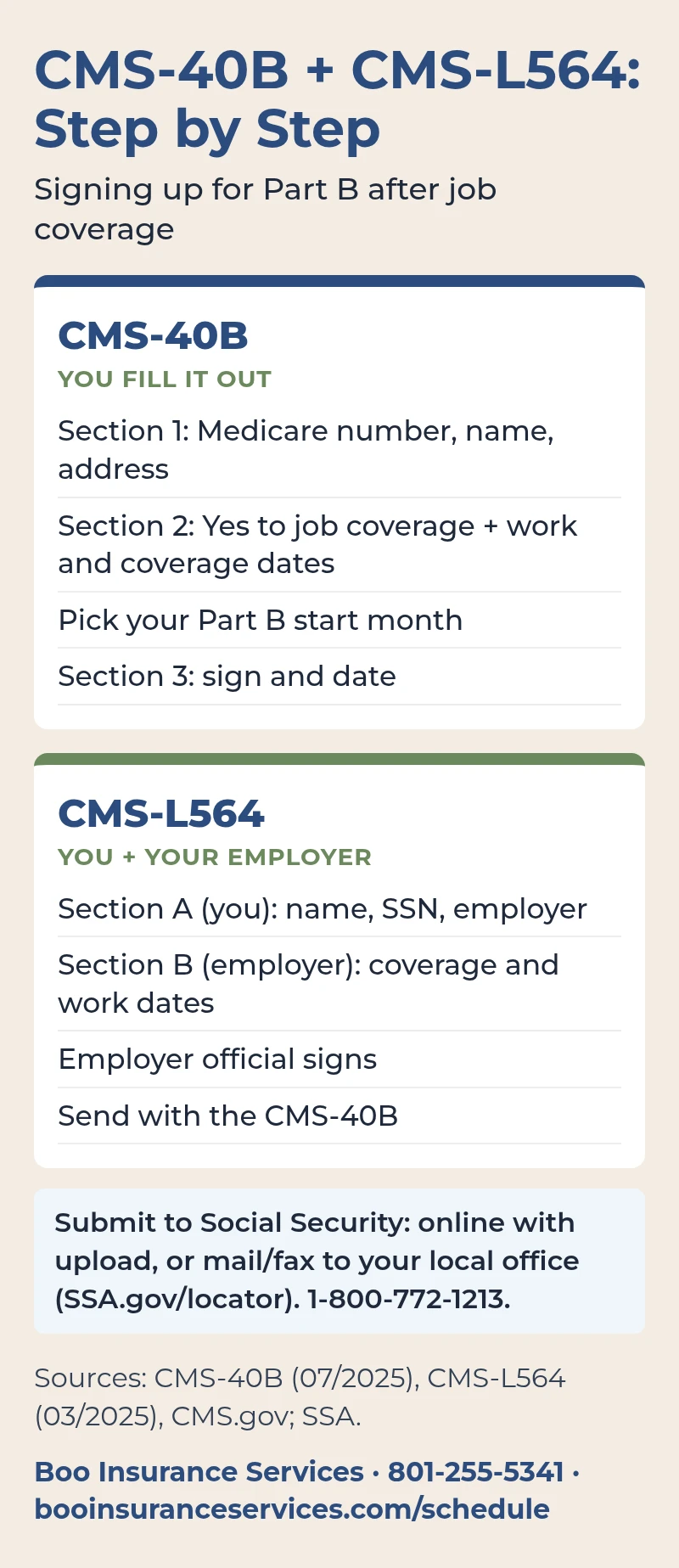
You fill this out if you already have Part A. On the current form (CMS-40B, 07/2025):
- Section 1: your Medicare number, name, mailing address, phone and email.
- Section 2: answer “Yes” to having coverage through an employer or union group health plan since you turned 65. Enter the dates you (or your spouse) worked for that employer and the dates of the health coverage (mm/yyyy), or check “Not ended.”
- Choose your coverage start date: the first day of the month you enroll, or the first day of any of the 3 months after.
- Section 3: sign and date.
CMS-L564: Request for Employment Information
This form proves you had job-based group coverage. On the current form (CMS-L564, revised 03/2025):
- Section A (you): your name and Social Security number, the employee’s name and SSN if the coverage is through your spouse, and the employer’s name and address.
- Section B (your employer): HR confirms whether you’re covered by the group plan, the dates coverage started and ended, the dates of employment, and signs it with a title and phone number.
Where to submit
Send both forms together to Social Security. You can mail or fax them to your local Social Security office (find it at SSA.gov/locator), or apply online through Social Security’s Part B sign-up page and upload the CMS-L564 or other proof. If your employer won’t complete Section B, Social Security accepts other proof, such as W-2s showing pre-tax medical contributions, pay stubs showing health premium deductions, or insurance cards with an effective date. Questions: call Social Security at 1-800-772-1213 (TTY 1-800-325-0778). (CMS – CMS-L564 · SSA blog – Sign up for Part B online, by fax, or by mail)
Want a second set of eyes on your forms?
There’s no cost to you for my help.
HSA RULES
HSA and Medicare: when contributions must stop
Medicare ends HSA contributions
Once you’re enrolled in any part of Medicare, your HSA contribution limit is zero, starting with the first month you’re enrolled. You can keep and spend the money already in the account. (IRS Publication 969)
The 6-month Part A lookback
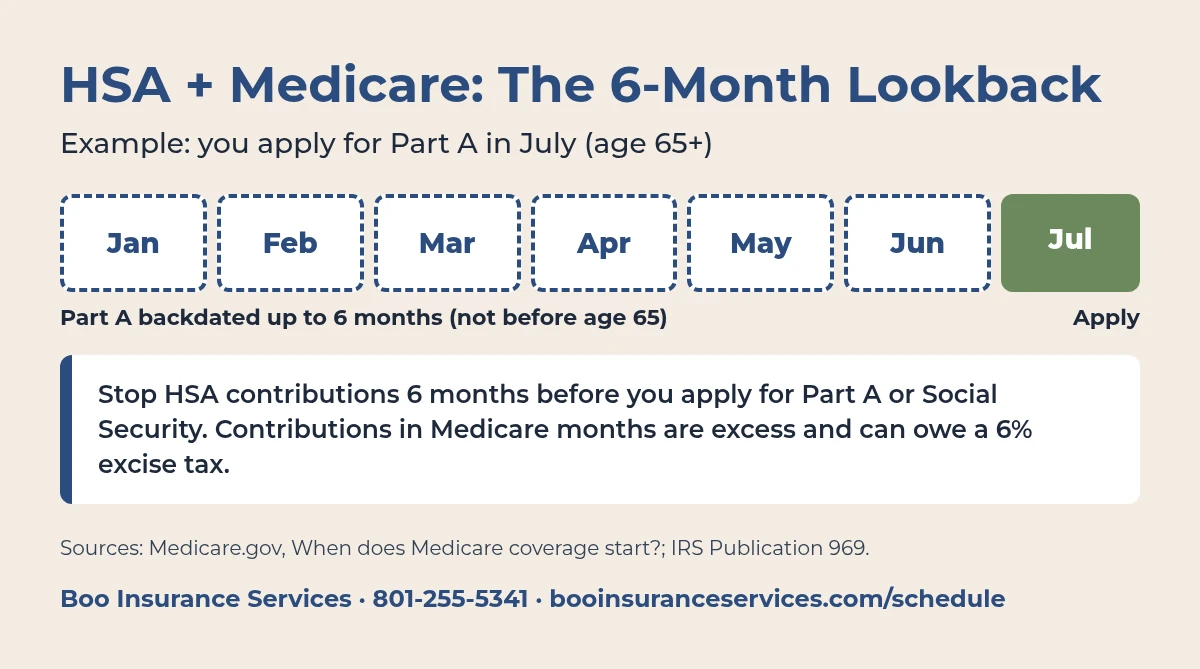
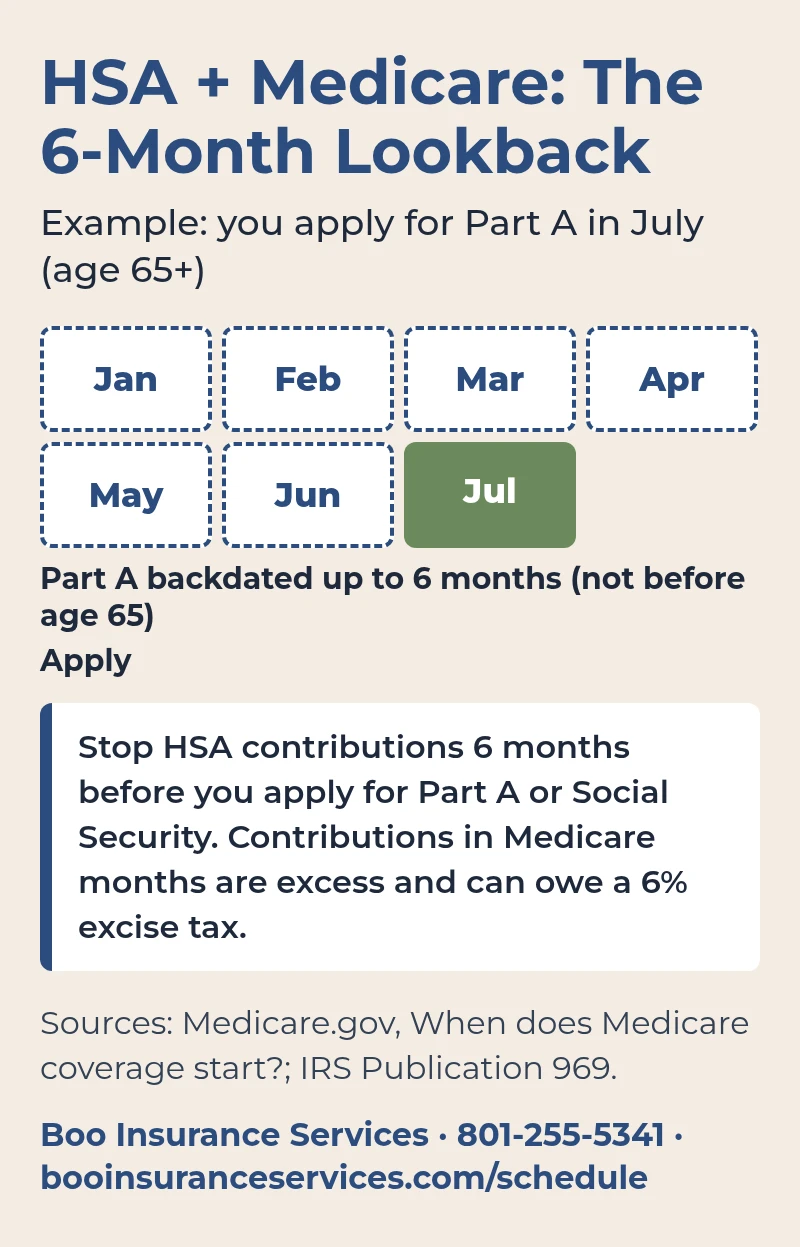
If you sign up for Part A (with no premium) after you turn 65, Part A coverage starts up to 6 months back from when you sign up or apply for Social Security benefits, but not earlier than the month you turned 65. The IRS treats those backdated months as Medicare months, so contributions made in them are excess contributions and can owe a 6% excise tax each year until removed. (Medicare.gov – When does Medicare coverage start? · IRS Publication 969)
Practical rule: stop all HSA contributions, yours and your employer’s, 6 months before you apply for Part A or Social Security retirement benefits (or by the month you turn 65, if that’s later). If you start Social Security, Part A starts too, so you can’t stay on an HSA once you collect.
Contribution limits in your last year
For 2026 the IRS limit is $4,400 for self-only coverage and $8,750 for family coverage, plus $1,000 if you’re 55 or older. In the year Medicare starts, the limit is prorated by the months before Medicare. For example, the IRS shows someone who turned 65 in July and enrolled in Medicare could contribute 6/12 of their limit. (IRS Publication 969)
After 65, HSA money can pay Medicare premiums like Part B and Part D, but not Medigap premiums.
COBRA
COBRA and Medicare: why COBRA doesn't protect Part B
COBRA isn’t coverage from current employment, so it doesn’t count for the Part B Special Enrollment Period. Your 8-month window starts when the job or job-based coverage ends, and getting COBRA doesn’t change when it ends. Medicare also lists “your COBRA coverage ends” as a situation that does not qualify for a Special Enrollment Period. If you’re 65 or older and on COBRA, Medicare generally pays first. (Medicare.gov – When does Medicare coverage start?)
The safest order for most people: sign up for Part B within the 8 months after work ends, then decide whether COBRA is worth keeping alongside it. Retiree coverage works the same way.
DRUG COVERAGE
Part D creditable coverage while you're still working
Your job plan’s drug coverage is creditable if it’s expected to pay, on average, at least as much as standard Medicare drug coverage. Employers must tell Medicare-eligible members each year, before October 15, whether it is. That notice also goes to people on COBRA. (CMS – Creditable Coverage)
- Creditable: you can delay a Medicare drug plan without a penalty. Keep the notice; you may need it later.
- Not creditable: if you go 63 days or more in a row without Medicare drug coverage or other creditable coverage after your first window, you may owe a Part D penalty of 1% of the national base premium ($38.99 in 2026) for each uncovered month, for as long as you have Part D. (Medicare.gov – Part D costs)
When the job coverage ends, you get a window to join Medicare drug coverage. Check your timing on the Medicare Open Enrollment Utah page and with the Medicare tools.
GET HELP
Neutral help and local help
Utah’s Senior Health Insurance Information Program (SHIP) offers unbiased Medicare counseling at no cost: 1-800-541-7735 (Utah DHHS Aging & Adult Services). You can also call 1-800-MEDICARE (1-800-633-4227; TTY 1-877-486-2048) or Social Security at 1-800-772-1213.
I’m Fores Boo, a licensed independent Medicare agent (NPN 17255694) with Boo Insurance Services in Draper, licensed since 2014. I’ve helped 1,000+ Utahns with Medicare, and we’re 5-Star Rated on Google. I’ll go over your employer coverage, your HSA timing and your forms by phone or video. There’s no cost to you for my help, and there’s no obligation.
COMMON QUESTIONS
Frequently asked questions
It depends on employer size. If your or your spouse’s current employer has 20 or more employees, the job plan usually pays first and you can often delay Part B without a penalty. If it has fewer than 20, Medicare usually pays first, so you generally should sign up for Part A and Part B on time.
CMS-L564, Request for Employment Information, proves you had group health coverage from current employment. You complete Section A, your employer completes and signs Section B, and you send it to Social Security with form CMS-40B to sign up for Part B during your Special Enrollment Period.
Send both to Social Security. You can mail or fax them to your local Social Security office, found at SSA.gov/locator, or apply online for Part B and upload the CMS-L564 or other proof of coverage. Call 1-800-772-1213 with questions.
No. Your HSA contribution limit is zero starting with the first month of Medicare. Because Part A taken after 65 can be backdated up to 6 months, stop contributions 6 months before you apply for Part A or Social Security. You can still spend the money already in your HSA.
No. COBRA isn’t coverage from current employment, so it doesn’t give you a Special Enrollment Period for Part B, and it doesn’t extend your 8-month window. If you wait on Part B while on COBRA, you may owe a late enrollment penalty.
Check the creditable coverage notice your employer sends each year before October 15. If it says your coverage is creditable, you can delay Part D without a penalty. If not, a gap of 63 days or more after your first window can mean a lifelong Part D penalty.
Get your still-working-at-65 plan checked
Grab your employer’s benefits summary, your HSA statement and your creditable coverage notice, and we’ll map out your Medicare dates together.
There’s no cost to you for my help.
NEXT STEP
Sources
- Medicare.gov, Who pays first?: https://www.medicare.gov/health-drug-plans/coordination/who-pays-first
- Medicare.gov, How Medicare Works with Other Insurance (publication 02179): https://www.medicare.gov/publications/02179-how-medicare-works-with-other-insurance.pdf
- Medicare.gov, When does Medicare coverage start?: https://www.medicare.gov/basics/get-started-with-medicare/sign-up/when-does-medicare-coverage-start
- Medicare.gov, Avoid late enrollment penalties: https://www.medicare.gov/basics/costs/medicare-costs/avoid-penalties
- Medicare.gov, How much does Medicare drug coverage cost?: https://www.medicare.gov/health-drug-plans/part-d/basics/costs
- CMS, CMS-40B Request for Enrollment in Medicare Part B (07/2025): https://www.cms.gov/medicare/cms-forms/cms-forms/downloads/cms40b-e.pdf
- CMS, CMS-L564 Request for Employment Information (03/2025): https://www.cms.gov/medicare/cms-forms/cms-forms/downloads/cms-l564e.pdf
- CMS, CMS-L564 instructions: https://www.cms.gov/cms-l564-request-employment-information
- CMS, Creditable Coverage: https://www.cms.gov/medicare/employers-plan-sponsors/creditable-coverage
- IRS, Publication 969 (Health Savings Accounts): https://www.irs.gov/publications/p969
- Social Security, Sign up for Medicare Part B online, by fax, or by mail: https://www.ssa.gov/blog/en/posts/2024-10-17.html
- Utah DHHS Aging & Adult Services, SHIP: https://daas.utah.gov/seniors/
Last updated: October 2026
Disclaimer: We do not offer every plan available in your area. Any information we provide is limited to those plans we do offer in your area. Please contact Medicare.gov, 1-800-MEDICARE, or your local State Health Insurance Program (SHIP) to get information on all of your options.
Not connected with or endorsed by the United States government or the federal Medicare program. National Producer Number: 17255694
About the author: Fores Boo is a licensed independent Medicare agent, NPN 17255694, with Boo Insurance Services, 61 W 13490 S Ste 201, Draper, UT 84020 · 801-255-5341. Reviews are by phone or video.