
This turning 65 Medicare checklist walks Utahns through the 7-month Initial Enrollment Period: what to do about 6 months before 65, when the window opens, during your birthday month, and after. Download the free one-page printable PDF below — no email needed — or follow the steps on this page.
Sources: Medicare.gov: When does Medicare coverage start? · SSA: Sign up for Medicare
Key takeaways
- Your Medicare enrollment checklist centers on a 7-month window: 3 months before your birthday month, that month, and 3 months after.
- Sign up in the first 3 months and Part B starts the month you turn 65.
- Still working with a job plan of 20 or more employees? You can often delay Part B; ask whether drug coverage is creditable.
- After Part A and Part B, choose between Original Medicare + Medigap + Part D or a Medicare Advantage plan — neutrally, neither path fits everyone.
- Apply with Social Security online, at 1-800-772-1213 (TTY 1-800-325-0778), or at a local office.
Download the printable one-page checklist
Free printable checklist · US Letter PDF · no email needed · for you, or to hand to a client
Download PDF Questions? Call 801-255-5341Mon–Fri 9am–5pm MT · TTY 711 · There’s no cost to talk with us
We’re Boo Insurance Services, a licensed independent Medicare agency in Draper. This page is a compressed, ungated version of the timing steps in Fores’s Turning-65 Roadmap — built so CPAs, financial planners, home care agencies, and senior centers can print one page and hand it to clients.
Medicare enrollment checklist: your 7-month window
Your first chance to sign up for Medicare Part A and Part B is your Initial Enrollment Period. It lasts 7 months (Medicare.gov):
- the 3 months before your 65th birthday month,
- your birthday month, and
- the 3 months after.
When you sign up changes when Part B starts:
| If you sign up… | Part B coverage starts… |
|---|---|
| In the 3 months before your birthday month | The month you turn 65 |
| In your birthday month or the 3 months after | The month after you sign up |
If you qualify for Part A with no premium, it starts the month you turn 65. If your birthday is on the 1st, Medicare treats the month before as your birthday month, so the whole window moves one month earlier. Map your exact months with our Medicare enrollment dates tool.
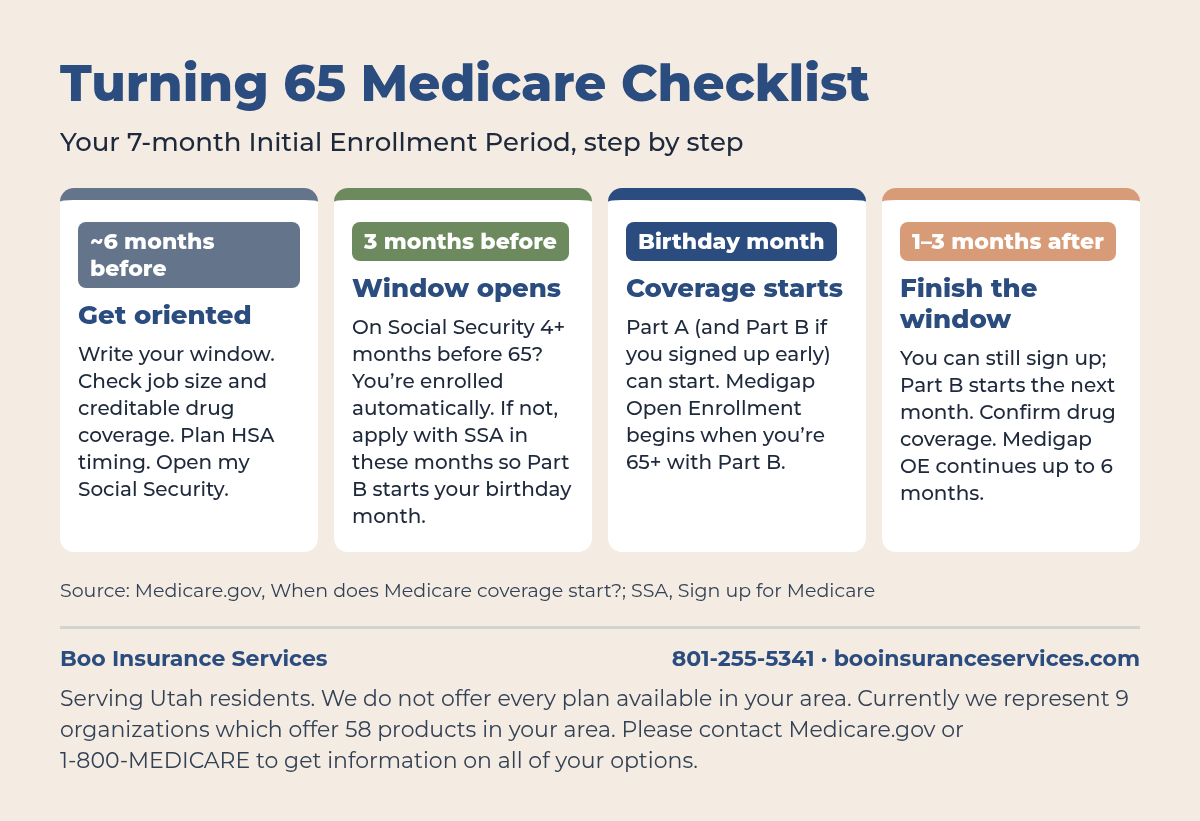
Turning 65 checklist: 6 months before to after
About 6 months before
- Write down your 65th birthday month and count out the 7-month window.
- If you or a spouse still work, note how many employees the employer has and ask HR whether the drug coverage is creditable.
- If you have an HSA, talk with HR or a tax professional. You can’t contribute to an HSA for any month you have Medicare. Part A taken after 65 can be backdated up to 6 months (not before the month you turn 65). People who delay Medicare generally stop HSA contributions 6 months before they apply for Part A or Social Security (IRS Publication 969; general information, not tax advice).
- Create or sign in to your my Social Security account at ssa.gov.
3 months before (window opens)
- Already getting Social Security or Railroad Retirement Board benefits at least 4 months before 65? You’re enrolled in Part A and Part B automatically; your card arrives about 3 months before coverage starts (Medicare.gov).
- Not getting those benefits yet? Apply with Social Security during these months so Part B can start the month you turn 65.
- Start a list of doctors, hospitals, pharmacies, and prescriptions.
Birthday month
- Part A usually starts this month for people who qualify for Part A with no premium.
- Part B starts this month if you signed up in the 3 months before.
- Your 6-month Medigap Open Enrollment Period starts the first month you’re 65 or older and have Part B (Medicare.gov).
1–3 months after
- You can still sign up; Part B then starts the month after you sign up.
- Confirm you have Part D or other creditable drug coverage so you don’t go 63 or more days without it.
- Medigap Open Enrollment continues for 6 months from your Part B start (if you’re 65+).
Still working at 65? Creditable coverage, Part B and HSAs
If you or your spouse have health coverage through a current job, timing can change. It mostly depends on employer size (Medicare.gov: Who pays first; Working past 65):
- 20 or more employees: the job’s group health plan usually pays first, and you can often delay Part B without a late enrollment penalty.
- Fewer than 20 employees: Medicare usually pays first. Plan to sign up for Part A and Part B during your 7-month window.
COBRA, retiree, and Marketplace coverage don’t count as coverage from a current job for delaying Part B.
When the job or that coverage ends, you have an 8-month Special Enrollment Period to sign up for Part B. It starts the month after the job or the coverage ends, whichever comes first. You’ll typically use CMS-40B (Part B application) and CMS-L564 (employment information; your employer completes Section B).
Ask HR for the notice that says whether your job’s drug coverage is creditable. If it is, join a Medicare drug plan or a Medicare Advantage plan with drug coverage within 2 full months after that coverage ends.
Two paths: Original Medicare + Medigap + Part D, or Medicare Advantage
Once you have Part A and Part B, there are two main ways to get the rest of your coverage. Neither one is right for everyone (Medicare.gov).
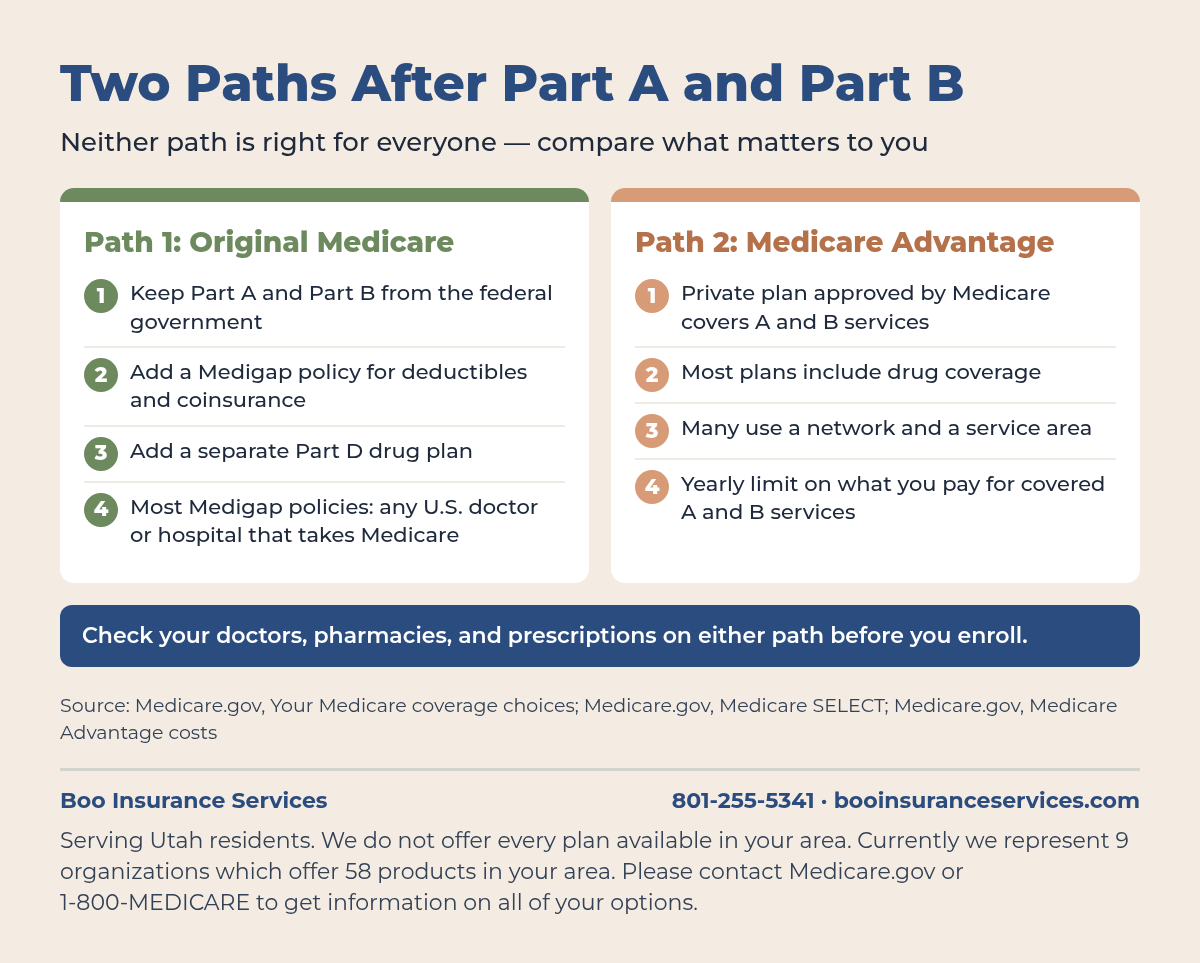
- Path 1 — Original Medicare + Medigap + Part D: You keep Parts A and B from the federal government, add a Medigap (Medicare Supplement) policy to help with deductibles and coinsurance, and add a separate Part D drug plan. With most Medigap policies, you can see any doctor or hospital in the U.S. that takes Medicare. Medicare SELECT policies are the exception: they use a network.
- Path 2 — Medicare Advantage (Part C): A private plan approved by Medicare covers your Part A and Part B services, and most include drug coverage. Many use a network and a service area, and some require referrals or prior authorization. Each plan has a yearly limit on what you pay for covered Part A and Part B services.
Medigap timing: Your 6-month Medigap Open Enrollment Period starts the first month you’re 65 or older and have Part B. During it, a company can’t turn you down or charge more because of your health, though it may make you wait up to 6 months for coverage of a pre-existing condition.
Avoiding Part B and Part D late penalties
Medicare has late enrollment penalties for Part B and Part D (Medicare.gov):
- Part B: 10% of the standard Part B premium for each full 12 months you could have had Part B but didn’t sign up. A Part B late enrollment penalty usually lasts as long as you have Part B. The 2026 standard Part B premium is $202.90 a month (CMS). We do not state a 2027 Part B premium here until CMS publishes it.
- Part D: 1% of the national base beneficiary premium for each full month after your Initial Enrollment Period that you went without Part D or other creditable drug coverage, if the gap lasted 63 days or more in a row. The base premium is $38.99 in 2026 and $41.33 in 2027 (CMS). People who get Extra Help don’t pay the Part D penalty. A Part D late enrollment penalty usually lasts as long as you have Part D coverage.
How we help people stay clear of them: sign up for Part B during your 7-month window unless you have coverage from a current job (yours or a spouse’s) with 20 or more employees; if you’re waiting because of job coverage, sign up within 8 months after the job or coverage ends; keep creditable drug coverage or join a Medicare drug plan. Estimate scenarios with our Medicare penalty calculator.
Check your doctors and prescriptions
- Original Medicare: ask whether each doctor accepts Medicare. With most Medigap policies you can see any doctor or hospital in the U.S. that takes Medicare.
- Medicare Advantage: ask whether each doctor is in the plan’s network, and whether you’ll need referrals or prior authorization.
- Prescriptions: check each drug on the plan’s formulary and its tier; note prior authorization or step therapy; confirm your pharmacy is in network (and whether it’s preferred).
- Part D out-of-pocket cap: covered Part D drugs have a yearly cap on what you pay — $2,100 in 2026 and $2,400 in 2027 (Medicare.gov).
How to apply through Social Security
You apply for Part A and Part B with Social Security, not with an insurance company (SSA):
- Online at ssa.gov (my Social Security account).
- By phone: 1-800-772-1213 (TTY 1-800-325-0778).
- At a local Social Security office (use the locator on SSA.gov).
Step-by-step for Utahns: how to apply for Medicare in Utah.
What to have ready
- Your Social Security number
- Your place of birth (city, state, country)
- Start and end dates of any current group health plan, and any group health plans since you turned 65
Questions? Call our team
Mon–Fri 9am–5pm MT · TTY 711 · There’s no cost to talk with us
Download the printable checklist
The one-page US Letter PDF mirrors this timeline with checkboxes. It’s ungated — no email needed — so partners can print and share it.
Download: Turning 65 Medicare Checklist – Boo Insurance (PDF)
Want the full step-by-step kit?
The Turning 65 Roadmap goes deeper on each step, from your enrollment window to comparing your two paths. It’s a free email download (separate from this printable checklist).
Related guides
Serving Utah residents. We do not offer every plan available in your area. Currently we represent 9 organizations which offer 58 products in your area. Please contact Medicare.gov or 1-800-MEDICARE to get information on all of your options.
Boo Insurance Services Inc. · Fores Boo, licensed independent Medicare agent · NPN 17255694 · 61 W 13490 S Ste 201, Draper, UT 84020 · Not connected with or endorsed by the United States government or the federal Medicare program.
Frequently asked questions
What is a turning 65 Medicare checklist?
A turning 65 Medicare checklist is a time-ordered list of steps around your 65th birthday: finding your 7-month Initial Enrollment Period, deciding whether to delay Part B if you have job coverage, choosing between Original Medicare with Medigap and Part D or a Medicare Advantage plan, checking doctors and prescriptions, and applying with Social Security. Ours is a free one-page printable for Utah residents, with no email required to download.
When does the Medicare enrollment checklist start?
Plan about 6 months before your 65th birthday month. Your Initial Enrollment Period itself opens 3 months before your birthday month and runs through 3 months after. Signing up in the first 3 months means Part B starts the month you turn 65.
Do I need Medicare if I’m still working at 65?
It depends on your job coverage. With a current employer that has 20 or more employees, the group plan usually pays first and you can often delay Part B without a late penalty. With fewer than 20 employees, Medicare usually pays first, so plan to sign up during your window. COBRA, retiree, and Marketplace coverage don’t count as coverage from a current job. HSA contributions must stop for any month you have Medicare.
What are the two paths after Part A and Part B?
Path 1 is Original Medicare plus a Medigap policy and a separate Part D drug plan. Path 2 is a Medicare Advantage plan that covers Part A and Part B services and often includes drugs. Neither path is right for everyone; networks, travel, doctors, and prescriptions all matter.
How do I avoid Part B and Part D late penalties?
Sign up for Part B during your 7-month Initial Enrollment Period, or during an 8-month Special Enrollment Period after coverage from a current job ends. For Part D, keep creditable drug coverage or join a Medicare drug plan so you don’t go 63 or more days without coverage. Part B’s late penalty is 10% of the standard premium for each full 12-month period you waited; Part D’s is 1% of the national base beneficiary premium per full month without creditable coverage after a 63-day gap.
How do I apply for Medicare in Utah?
Apply with Social Security: online at ssa.gov, by phone at 1-800-772-1213 (TTY 1-800-325-0778), or at a local Social Security office. Have your Social Security number, place of birth, and group health plan dates ready. If you already get Social Security benefits at least 4 months before 65, you’re usually enrolled automatically.